
Features
Insurgency 1971: Memoirs of then PM’s Secretary


(Excerpted from the autobiography of MDD Peiris)
From about the end of 1970 there was persistent and disturbing information surfacing of a youth uprising. Intelligence was coining in about secret meetings in the night; clandestine classes on far left ideologies; weapons training; the manufacture of hand bombs, etc. By the beginning of 1971 it was becoming clear that something dangerous was afoot.
All this information related to the gradual development of a situation that was unprecedented. In retrospect it could perhaps be said, that because it was unprecedented, the government did not, in those early months, accord to it the serious attention, that in hindsight, it could be said that it warranted. The intelligence services themselves, were able to unearth considerable material, but nobody developed a coherent and comprehensive picture of the ramifications and the magnitude of the problem.
The government reacted to the progressively increasing information that was coming in by setting up a special unit at Temple Trees headed by Mr. S.A. Dissanayake, a former Deputy Inspector General of Police. This unit was gradually staffed with a core of officers drawn from the three services and the police. and it was progressively strengthened with the necessary equipment. During this period the Prime Minister was residing in her own home at Rosmead Place. Temple Trees was only used
for state occasions. Apart from its use for receptions and dinners, visiting dignitaries like Prime Minister Lee Kuan Yew were lodged there.
On the afternoon of April 4, 1971, I had gone to see the Prime Minister with a whole lot of papers. We were working at the dining table at Rosmead Place, when one of the servants came and announced that the Army Commander General Attygalle had come, and that he wished to see the Prime Minister urgently. He was ushered in, and what he had to relate was alarming. Security officers had raided a small meeting of insurgents at Vihara Maha Devi Park in Colombo a few hours before, and the subsequent interrogation of suspects had revealed a plot to storm Rosmead Place, and kill the Prime Minister that very night.
This had been confirmed by another, who had relented at the last moment and given information to the authorities. General Attygalle wanted the Prime Minister to immediately move to Temple Trees, which could be adequately secured. The Prime Minister with her customary calm said “I am not leaving my home, you protect me here.” But the general was adamant. He pointed out the vulnerability of the location of Rosmead Place right at a junction with roads all around it, and with its boundary walls abutting these roads.
In the developing context, he rightly urged that the Prime Minister should leave. I too added my voice to the General’s and Dr. Mackie Ratwatte, her brother and Private Secretary, who came in whilst this conversation was going on added his own weight. We proposed that she stop her work, and get ready to leave immediately. But she was very reluctant to leave the comfort of her home, and it required more effort to get her to at last agree.
All this was to be kept absolutely secret. I gathered my papers and said I was going to office, and that I would be there if needed. The staff at Temple Trees were not informed about the Prime Minister coming there to reside. She was to make the necessary arrangements after she got in. I finished my work and went home late as Usual. I had no role to play in the technicalities of security arrangements. I was on call if necessary. I had a parallel line in my bedroom upstairs from the telephone downstairs, which I used to keep on a low stand near my bed, so that I could reach out and take a call without getting out.
I was fast asleep when the telephone rang. It was around four o’clock in the morning of April 5. At the other end was Mr. Amarasinghe, Additional Private Secretary to the Prime Minister. He was telephoning from Temple Trees. He related in dramatic fashion the information that was coming in about the attack on a number of police stations by the Janatha Vimukti Perumuna. He said that lists had been discovered, with names of prominent people, to be assassinated. He was also kind enough to say that my name “had not yet been found,” on such a list.
This was a great deal to absorb when woken up from deep sleep. I requested Mr. Amarasinghe to inform the Prime Minister that I would be coming to Temple Trees early in the morning, and that until then I would be at home. I knew difficult, and even dangerous days lay ahead; that all normal hours of work and rest were at an end; and that no program of any sort could be planned. One had to adjust to the developing situation.
My little son was just over two years old. Given the uncertainties, I did not want my wife and son to be at home. I knew that if they were away, I would have greater ease of mind. In any case they were unlikely to see much of me. My parents were at home, and we had a servant. We could manage. My wife suggested that we send our son to her parents in Negombo, and that she stay. I firmly rejected this and packed both of them off to her parent’s place later in the day.
When taking these decisions there was the thought at the back of my mind that if I happened to be on some hit list, it was best that I sallied forth to the after-world alone. In any case the contract of marriage with my wife pertained only to this world, and I saw no point in her being put at risk of such a journey to another world. There was also now an innocent two year old without any contract, but possessing only a birth certificate. Now began almost two months of intense work and activity, where any kind of time management was impossible.
The country had to be under curfew for a considerable period of time. At the beginning the curfew hours were quite severe. Normal office and work hours had to be substantially curtailed. I had now to work from Temple Trees. The focal point of administration and security was there. Very senior security personnel including the Navy Commander Admiral Hunter and Chief of Staff Basil Goonesekera, worked from the operations room at Temple Trees. Some Ministers also spent a great deal of their time at Temple Trees.
One of them whom I remember vividly was Dr. N.M. Perera the Minister of Finance. He had a look of shock and disbelief on his face. Much of the time he had a far away look. It was evident that he had been deeply shocked by the turn of events. He was struggling to comprehend something, which at the time he did not understand. I tried occasionally to talk to him, and also ask him whether I could order a cup of tea. Most of the time he just grunted. Conversation seemed to be the last thing on his mind.
Underlying the shock and the gloom from his point of view was the despair that a set of reckless adventurers were jeopardizing a socialist government which had been returned with such a strong mandate, even before the government was one year in office. Most of the Ministers were in a state of fear. They thronged Temple Trees and stayed there. After a while, this constituted a disturbance to the Prime Minister, who thereupon urged them to go and stay in their Ministries.
The security forces and the police were stretched to the limit. The country did not spend any significant amount on defence and security in those times, and was generally unprepared both in equipment and human resources to meet the kind of insurgent threat that they were now suddenly faced with. Therefore, the security that was afforded to Ministers at the time when compared with the security they receive now, was rudimentary. It was no wonder therefore that they tended to congregate at Temple Trees, the safest place available.
A discussion with the Army Commander
The first three or four days were particularly difficult. In addition to combating the sudden attack on about 25 police stations, with intelligence being received of more attacks to come, the Government was in a most difficult situation. Police stations had to be strengthened; troops had to be deployed against identified JVP centres, as intelligence began coming in; main roads, and most importantly bridges had to be secured: public offices had to be guarded; and Ports, harbours and above all airports, including the international airport had to be secured.
With inadequate personnel and equipment. the security forces and the police were under severe strain. Most of them had not slept for days, and some were on the verge of breakdown. The country was under extended hours of curfew, and rumours abounded of an attack on Colombo; about the prospect of some of the main bridges in the city being blown up; and about possible raids on reservoirs and pumping stations like the one at Maligakande.
It was in this environment and background that General Sepala Attygalle the Army Commander telephoned me one morning at Temple Trees. This would have been around the third day of the insurgency. He sounded seriously overwrought. He said that the situation was very bad and that he wanted to see the Prime Minister. This was chilling news. But one had to discipline oneself not to get excited or panic. I told Sepala, that I would certainly arrange for him to see the Prime Minister, but that first I needed to talk to him.
I was working in the administrative building situated to the north of the main building, where the Prime Minister worked from. On top of the administrative building were some bedrooms. Pending the Army Commander’s arrival, I went into the situation room, and got myself briefed on the latest information. It was clear from the briefing that the initial assault had been to an extent countered, although some police stations were lost or had to be abandoned.
The wave of attacks had petered out and the security forces were consolidating. The volunteer forces of the three services had been called up and the increased manpower coming in were helping both operations and morale. The curfew was being strictly enforced, and orders had gone out to shoot any deliberate curfew breakers. The government had already appealed to countries such as India, Pakistan, The United Kingdom and the USA for urgently needed arms, ammunition and equipment.
There were very positive responses from all these countries as well as later China. India and Pakistan were sending helicopters, in addition to other supplies. They were also sending some of their troops to secure the Katunayake and Ratmalana airports, so that our troops could be released from static duties. Our two neighbouring countries acted very fast. I remember Pakistan responding to our request by immediately cabling “Helicopters loading, please indicate landing details.” They were sent in military cargo planes.
We were also urgently buying ammunition and equipment from Singapore. I knew that all this was in the pipeline, and some had actually arrived. The Indian High Commissioner had met the Prime Minister, and after discussions, the Indian Navy threw a naval cordon around the country and intensified naval patrols. I was most keen therefore to talk to Sepala, because I was certain that he did not know of these details. When he arrived, I took him upstairs to one of the bedrooms, and shut the door. We sat on two beds and talked. It was abundantly clear that he had not slept for almost three days. The strain was visible. He was chain smoking and his hands were trembling, a sign of tension, fatigue and sleeplessness. I calmly narrated the briefing I had received from the situation room.
I then updated him on the arrival of the helicopters, troops and equipment. We talked for almost 45 minutes. At the end Sepala decided he did not need to see the Prime Minister. I suggested that he sleep in the room for a few hours. But he had work to do, and left in a much better frame of mind.
Operation Rescue
One of the main problems initially was the inadequacy of personnel, even for static security duties. The Minister of Public Administration and Home Affairs, Mr. Felix Dias Bandaranaike decided that a number of selected senior public servants, who in any case did not have much to do, due to the long curfew hours, could assist security personnel at some of the check points in the city. A roster had been drawn up and they were to report for duty at various places during early evening.
Unfortunately, under the pressure of events someone forgot to co-ordinate this with the security authorities. Some kind of letter was issued to them. But some had not received their letters by the time they were asked to report. We had no national identity cards those days, and there was now the prospect of a number of senior public servants wandering into military check points in the dark, without a shred of identification in a situation when those manning those points were completely unaware of this arrangement, and were themselves tired, tense and edgy.
Very fortunately the Prime Minister came to hear of this at the last moment. She was furious. Already there were deaths enough, and the last thing she wanted to see was a number of senior public servants added to those numbers. On her instructions therefore, we had to quickly organize a fleet of vehicles to send to the various check points and bring these public servants to Temple Trees.
Getting vehicles at such short notice was also not easy. We had to drop everything and engage in operation rescue. To the great relief of all however operation rescue was successfully carried out and a number of bewildered public servants brought to Temple Trees, where most of them spent the night, some of them seated on the steps at the back, overlooking a beautiful lawn and shady trees.


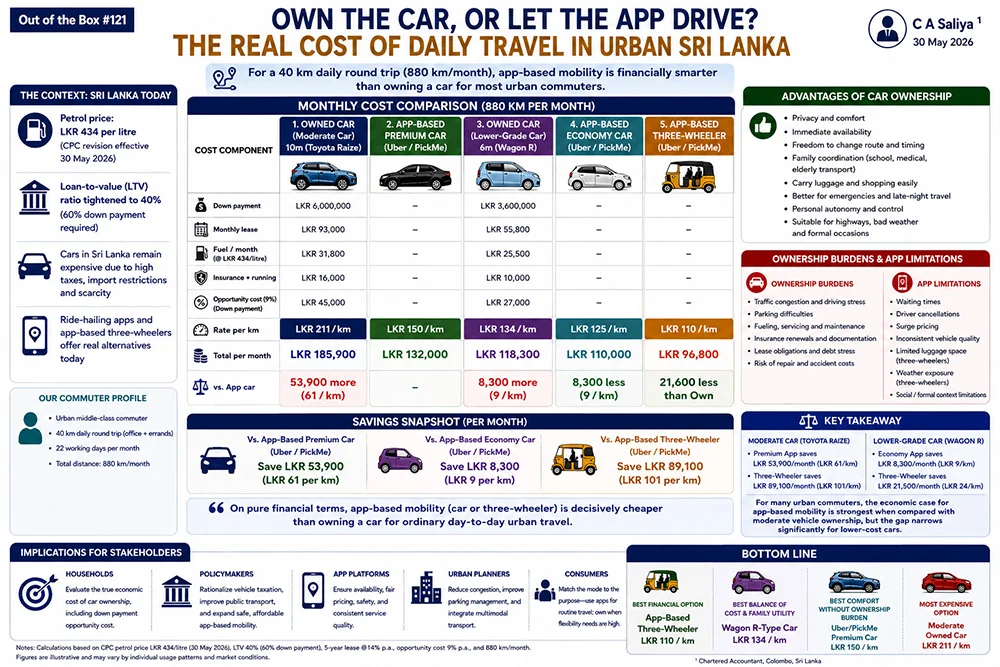
The real cost of daily travel in urban Sri Lanka
 For many middle-class Sri Lankans, the private car still carries connotations of stability, dignity, and upward mobility. Yet in today’s Sri Lanka, with petrol at Rs. 434 per litre, following the Ceylon Petroleum Corporation’s revision, effective 30 May, 2026, loan-to-value ratios tightened to 40% requiring a 60% down payment, and ride-hailing apps now joined by app-based three-wheelers, the question of whether to own a car has become sharper than ever. The answer is not emotional but economic: for ordinary day-to-day travel, is it actually cheaper and wiser to own a car, or to let the app do the work?
Take a generic urban Sri Lankan commuter making a 40 km daily round trip to office and back, with routine errands built in. That is about 880 km a month across 22 working days. At that level of usage, the arithmetic becomes surprisingly clear: for a large group of moderate urban users, app-based mobility, whether a car or a three-wheeler, is financially smarter than owning a car, unless the non-financial benefits of ownership matter deeply enough to justify the premium.
The Sri Lankan distortion:
cars cost too much
In most developed economies, cars are consumer durables. In Sri Lanka, they behave more like luxury financial assets. A moderate vehicle, such as a Toyota Raize or Honda Civic, often costs several times what a comparable car would in a developed market, once taxes, import restrictions, and scarcity are priced in.
Assume a moderate privately used car priced at 10 million. Under the Central Bank’s current 40% LTV directive, the buyer may borrow only 40% against the vehicle’s value, requiring a 60% down payment of 6 million and a five-year lease on the remaining 4 million. At a typical Sri Lankan leasing rate of 14% per annum, the monthly lease instalment comes to approximately 93,000. A moderate petrol vehicle averages around 12 km per litre in urban traffic. At Rs. 434 per litre, fuel cost alone is 36 per km, or 31,800 per month for 880 km. Add insurance of 12,000 and a conservative 4,000 for routine running costs, and total cash outgoings reach approximately 140,800 per month.
But cash outgoings alone understate the true cost. The 6 million down payment, if invested elsewhere at 9% per annum, would generate approximately 45,000 per month in foregone return. Adding this opportunity cost, the full economic cost of the moderate car rises to 185,900 per month, or 211 per km.
The app alternatives: car or three-wheeler
Urban Sri Lankan commuters today have many distinct app-based mobility options, each serving different journey types and comfort preferences.
Uber and PickMe (car hire): A premium car hire through Uber or PickMe costs approximately 150 per km. For 880 km of monthly travel, that comes to 132,000 per month. Compared with the moderate owned car at 185,900, the app saves 53,900 per month, or 61 per km. On purely financial terms, the app wins decisively.
App-based three-wheelers: App-based three-wheelers currently charge approximately 110 per km. For 880 km, that is 96,800 per month, saving 89,100 per month and 101 per km compared with the moderate owned car. The tuk-tuk app is the most economical of the three mobility options for short urban trips, though clearly unsuitable for highway travel, poor weather, carrying passengers in formal settings, however, it represents a compelling financial case.
Non-financial advantages of ownership
Transport decisions are never purely accounting exercises. A private car offers privacy, immediate availability, flexibility, and family utility in ways that no app can fully replicate. With your own car, you can leave when you want, stop when you want, change route mid-journey, carry files or groceries without thought, respond to emergencies, and avoid the uncertainty of waiting for a driver to accept your ride. It also becomes a family coordination tool: school drop-offs, medical visits, elderly passengers, unplanned errands, and weekend travel all become easier. In psychological terms, ownership buys autonomy. No app-based alternative, whether car or three-wheeler, provides that.
The hidden burden of car ownership and app limitations
Yet the same car creates stress. Urban Sri Lankan driving is rarely relaxing. Congestion is exhausting, lane discipline is weak, and parking is a recurring headache. Every daily driver absorbs cognitive fatigue that accumulates invisibly over months.
Uber and PickMe remove the burden of driving, fuelling, and servicing. But they introduce their own friction: waiting times, driver cancellations, surge pricing during peak hours or rain, and inconsistent vehicle quality. App three-wheelers add further constraints, limited luggage capacity, exposure to weather, and social context limitations. The app does not eliminate inconvenience; it transforms driving stress into coordination stress.
There is also the administrative burden of ownership that many buyers underestimate. A car is not just a vehicle; it is an asset management project. Lease payments must be tracked, insurance renewed, service appointments remembered, tyres monitored, and documents maintained. Even a low-maintenance new car carries the persistent fear that one breakdown or accident can create a large unexpected outflow. The app user, by contrast, simply pays for completed trips, no garage anxiety, no debt-linked asset stress, no renewal calendar.
Sensitivity analysis: what if the car is a lower-grade Wagon R?
The picture changes if the household opts for a lower-grade entry-level vehicle. Assume a Suzuki Wagon R or equivalent at 6 million, again with a 60% down payment of 3.6 million and a five-year lease on 2.4 million. At 14% per annum, the monthly lease instalment is approximately 55,800.
The smaller car delivers better fuel economy, around 15 km per litre. At 434 per litre, fuel cost becomes 29 per km, or 25,500 per month for 880 km. Add insurance of 7,000 and running costs of 3,000. Including opportunity cost at 9% on the 3.6 million down payment (27,000 per month), the total economic cost is 118,300 per month, 134 per km.
Now the comparison becomes more nuanced. A lower-grade Uber or PickMe alternative costs around 125 per km, or 110,000 per month for 880 km. The gap narrows dramatically: owning the Wagon R costs only 8,300 more per month, just 9 per km, compared with the app car option. The app three-wheeler at 110 per km (96,800 per month) is still materially cheaper, saving 21,500 per month against the lower-grade owned car. (See Table 1)

So, what should an urban Sri Lankan do?
If you travel alone on routine urban routes, the app three-wheeler at 110/km is the most economical option by a wide margin, saving up to 89,100 per month against a moderate owned car. Its limitation is not financial but practical: unsuitable for families, formal occasions, highway travel, and bad weather, but convenient-no stress.
For families, formal occasions, highway travel, and bad weather and convenient-no stress, Uber or PickMe Moderate car at 150/km delivers private-car comfort without the asset burden, saving 53,900 per month against the moderate owned car. The saving is if you get an economy APP car.
If you need family flexibility, late-night mobility, or privacy, ownership remains rational, but preferably through a lower-grade car around 6 million. At 134/km, the Wagon R-type car is only 9/km more than the app car alternative and 24/km more than a tuk-tuk, a gap that autonomy, family convenience, and immediate availability can legitimately justify.
Therefore, in Sri Lanka’s distorted vehicle market, with fuel at LKR434/lt, a 60% mandatory down payment, the Wagon R-type leased car remains relatively a better choice for a family with moderate earnings.
The private car still offers freedom. But in 2026 Sri Lanka, that freedom comes at very different prices. The real question is how much each household can afford to pay for autonomy, prestige, and convenience, and whether the extra 61/km for a moderate leased car, against a perfectly capable app car, or 101/km against a tuk-tuk app, represents a rational expenditure of household income. For most salaried urban commuters, the honest answer is: probably not.
(The writer, a senior Chartered Accountant and professional banker, is Professor at SLIIT, Malabe.
Views expressed in this article are personal.)
The legal processes are steadily closing in on some of the most controversial cases that have remained as open questions without closure for many years. These include the Easter Sunday bombings of 2019, the Treasury bond scam that erupted in 2015, and a range of corruption allegations that became synonymous with successive governments over the past two or more decades. What once appeared to be stalled investigations are now showing signs of movement through the courts and investigative agencies. Recent developments suggest that these long running cases are entering a decisive phase. In the Easter Sunday attacks investigation, new arrests and investigations have brought renewed attention to allegations that extend beyond the immediate perpetrators and into questions of intelligence failures and possible political complicity. The arrest and detention of former intelligence chief Suresh Sallay under the Prevention of Terrorism Act has intensified public interest in uncovering the full truth behind the attacks.
The Treasury bond scam has also re-entered the spotlight. The Supreme Court has recently overturned legal obstacles that had prevented prosecutions from proceeding and directed that the case moves forward expeditiously. This has reopened one of the most sophisticated financial scandals in the country’s recent history and brought several prominent political and financial figures back under legal scrutiny. As those implicated in these unresolved cases are leading figures from previous governments, which have spanned both sides of the political divide since Independence, it can well be imagined that there is tremendous opposition to the gradually enveloping legal processes that is both seen and unseen.
These cases that are now being investigated cut across political camps and involve individuals who occupied some of the highest offices in the country. The result is that resistance to accountability is likely to emerge from many quarters. Still to be opened are the thousands of cases of persons gone missing during the war. Presidential Commissions have been appointed with regard to them, but there has been no serious investigations of the type now taking place.
In these circumstances, it can be surmised that the government led by those who are new to power would wish to retain a maximum of power to face the pushback that is bound to emerge from those in the opposition who have wielded power for generations. The government may calculate that this is not the time to disperse authority or reduce the instruments of state power available to it. Instead, it may believe that a period of centralised control is necessary if investigations, prosecutions and reforms are to proceed without interference.
Provincial Elections
It appears that the opposition’s efforts to mobilise the people and public opinion against the government have not been successful so far. One such instance was the attempt to generate opposition to price increases. Although people have undoubtedly been affected by rising prices and economic difficulties, these efforts failed to gather significant momentum. Another attempt came when President Dissanayake predicted that opposition politicians would face imprisonment in the month of May as legal cases progressed, though this has not happened. Critics claimed that such remarks suggested an intention to influence judicial outcomes. Yet this criticism also failed to gain traction among the public. The likely reason is that public memory remains fresh. Many people continue to associate previous governments with economic mismanagement, corruption scandals, abuse of power and the eventual economic collapse. In comparison, the present government continues to enjoy a reservoir of public goodwill and credibility. As long as legal action appears to be based on evidence and proper process, the public seems prepared to give the government the benefit of the doubt.
The government’s deliberate and cautious approach to political reform that would reduce its centralised power needs to be seen in this context. The monthly approval by Parliament of the emergency regulations is justified by the government as due to the continuing need to respond to the devastation caused by Cyclone Ditwah. However, when viewed together with the reluctance to hold provincial council elections on the grounds of electoral reform, the failure to repeal the Prevention of Terrorism Act and the postponement of constitutional reform, they all appear to reflect a preference for retaining maximum control at a politically sensitive moment. There is a logic to this approach. Governments facing major legal and political confrontations often seek stability and control. So does every despot. However, there is also a downside.
When political competition is denied to legitimate outlets, it often finds expression in confrontation, obstruction and polarisation. The advantage of prioritising the conduct of provincial council elections at this time is that it could reduce the political pressures that are building up. The main opposition parties are united in calling for these elections to be held. Conducting them would provide an opportunity for opposition political parties to obtain a measure of democratic representation and political authority at the provincial level. This would be especially true in the northern and eastern provinces, in which the ethnic and religious minorities predominate. It cannot be forgotten that the provincial council system was developed as a constructive response to the ethnic conflict. Elections at the provincial level would create opportunities for a new generation of political leaders to emerge through democratic competition rather than patronage. Many of those now facing legal scrutiny belong to an older generation to whose needs the younger may be less deferential.
Two Pillars
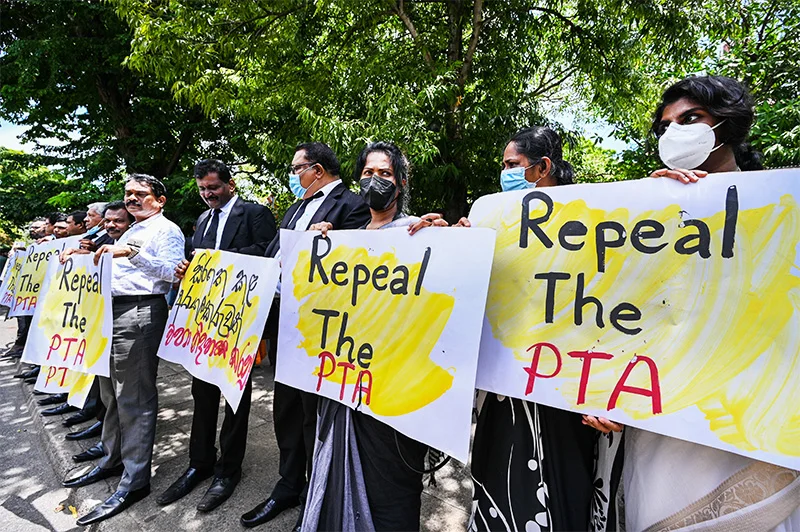
Another reform that could command bipartisan support is the repeal of the Prevention of Terrorism Act. The PTA has once again become controversial because it is being used in situations that extend beyond its original purpose. The detention of former intelligence chief Suresh Sallay under the Act, the continued incarceration of some Tamil detainees from the war period, and the arrest of individuals accused of speech related offences have all revived concerns regarding prolonged detention without trial and excessive executive power. The reason the PTA has been difficult to repeal is that it is closely associated with concerns regarding national security and territorial integrity. Introduced in 1979 as a temporary measure to confront the emerging separatist conflict, it survived through decades of war and has remained on the statute books long after the conflict ended.
At the same time, history shows that extraordinary powers are likely to be misused. Laws that permit detention without trial or broad executive discretion are rarely confined to their original purpose. Governments of different political parties have used such powers against opponents and critics. The temptation to do so is inherent in the possession of unchecked authority. The way forward could therefore be a combination of accountability and reform. The government should continue to support independent investigations and prosecutions in major corruption and security related cases. Demonstrating political will in this regard would strengthen public confidence in the rule of law and reinforce the principle that no individual is above the law. The PTA could be replaced with legislation that amends the Criminal Procedure Code and Penal Code in a manner that addresses legitimate security concerns while complying with democratic norms and human rights standards.
There are also international dimensions to consider. The European Union has repeatedly linked governance and human rights reforms, including reform of the PTA, to Sri Lanka’s continuing access to the GSP Plus trade concession. Progress on these issues would strengthen Sri Lanka’s international standing at a time when economic recovery remains a national priority. The government has a rare opportunity. It possesses a strong electoral mandate, public goodwill and a reputation for integrity that previous governments lacked. It can combine the pursuit of justice in long delayed cases with meaningful democratic reforms that reduce political resistance and broaden public support. At this time, accountability and power sharing are the two pillars which Sri Lankans need to be committed to build a just and democratic society for a better future without delay. Failure now would make for a long period of waiting for the next time.
by Jehan Perera

 A public university relies on its teachers in fulfilling its responsibilities to the wider community. While teaching remains the chief responsibility of the academic staff, they also conduct research and play a central role in keeping the university a vibrant space where they and students can freely participate in conversations that concern not just routine classroom education but also society at large. The broader intellectual culture and intellectual integrity of a university thus depend on how its academics perform their functions. Therefore, universities should take the task of recruiting their academics seriously. It is important to ensure that this task is done responsibly, transparently and credibly through a fair, thorough and multi-phased evaluation process.
As both an applicant and a member of selection panels for recruitment, I hold that the recruitment procedures, currently in place in our university system, require radical reforms. Echoing some of the concerns raised by Kaushalya Perera in her Kuppi article on recruitment in March 2026, I focus on the limitations I have observed and experienced, specifically in the recruitment of Lecturer (Probationary) and Senior Lecturer positions. The article also aims to explore how these shortcomings could be addressed.
The Advertisement
Recruitment for Lecturer (Probationary) and Senior Lecturer positions is done through an open-advertisement which also involves an interview with shortlisted candidates. Advertisements are finalised in line with a template issued by the Registrar’s Office. Generally, an initial draft, prepared by the Registrar’s Office, is sent to the relevant academic departments for revisions. The revisions have to be made within the template provided, which allows space for the mention of only specialisation requirements.
It should be noted that not all revisions to the advertisement, suggested by the Department Head, are accepted in the next round. Deans, Vice Chancellors and Registrars, who have very little understanding of the disciplines associated with the position, sometimes reject the changes proposed by the Department. Technocratic in their thinking, they don’t recognise that an academic programme can be taught by persons with specialisation in another overlapping discipline. For instance, a position in English, at a university in Sri Lanka, is very well suited to not just those who have postgraduate qualifications in literary studies but also those who are from the disciplines of Applied Linguistics, Cultural Studies or Translation Studies, as these areas are taught as sub-fields of English studies at most universities in the country. These disciplinary overlaps, even when pointed out by Heads, are often overlooked by our administrators.
In place of this process, dominated by academic administrators and registrars, the advertisement should ideally emerge, from the relevant department, in the form of a comprehensive job description. It should mention the nature of the position advertised, the kind of teaching (and research) expected, how the position relates to other positions in the department, in terms of specialisation and workload, and the ways in which the recruited candidate would contribute to overall institutional development.
There can be no one-size-fits-all model when it comes to recruitment. Individual departments vary in size, strength and specialisation requirements. Departments with sizable academic staff may want to emphasise specialisation during recruitment, whereas smaller departments may prefer generalists who can handle a wide-array of courses. Specifying the rationale for the requirements included in the job description may help potential applicants get an understanding of the position advertised and the selection panel to conduct the evaluation process in a fair manner.
Review of Applications
Once applications are received, we sometimes find promising candidates but with qualifications that don’t carry in their title the name of the discipline or the department in which the position is advertised. Sometimes the disciplines or fields of specialisation that appear in the advertisement and the ones that appear in the qualifications are not identical in nomenclature, even though the research undertaken by the applicant during their graduate studies is strongly relevant to the position advertised. Even when such applications are accompanied by strong and relevant publications, our system does not view them positively. Instead, nomenclatural differences are used to reject promising candidates. Such differences are also used as a pretext when universities want to exclude a candidate for their cultural background, political beliefs or other reasons. Even if academic departments recognise such applications, at the next stage, the administrators of the university try to veto them. We lose inter-disciplinary scholars of high academic standing because of the high-handedness of university administrators.
Selection Panels
Selection panels for academic positions typically comprise the Vice Chancellor, the Dean of the Faculty, the Head of the Department, two academics nominated by the Senate and two members of the University Council. In the case of programmes/disciplines jointly housed under a single department, if the Head comes from a discipline other than the one in which the position is advertised, they may not be able to contribute in an informed manner to the recruitment process. However, some Heads refuse to appoint nominees from the relevant discipline in their place as they view sitting on selection panels as their exclusive privilege.
Sometimes university Senates do not take the appointment of Senate nominees seriously. These appointments are decided in a hurry without serious deliberations at senate meetings packed with numerous agenda items. Sometimes even if the relevant department has suitable academics to serve as Senate nominees, the Senate chooses academics from other departments or disciplines who do not have a nuanced understanding of the requirements of the position advertised and its disciplinary parameters. Sometimes specialists in the relevant discipline may not be available at a university. On such occasions, Senates tend to fill up the positions with academics from other disciplines, instead of inviting external nominees from other universities. At a state university in Sri Lanka, I was interviewed thrice for academic positions by selection panels that comprised not even one specialist from the relevant discipline.
The Marking Scheme
The marking schemes used in recruitment have their own drawbacks. Publications are sometimes evaluated for their quantity rather than quality. The opinion of the subject specialist is not sought or taken seriously when a candidate’s research is evaluated. This is why our universities are saddled with academics who engage in plagiarism or predatory publishing. The evaluation process should be tightened in such a way to bar the entry of those who lack academic integrity.
It is worrying to see that marking schemes and schemes of recruitment penalise applicants who have excelled in their graduate studies and are well-reputed for their recent research and publications just because they did not earn a first-class or second-class upper-division pass at the undergraduate level. Our narrow focus on a candidate’s first degree prevents us from giving due recognition to how that person has gained intellectual depth over the years. Some marking rubrics, which allocate points for eye-contact and posture during the interview, dilute the seriousness associated with the academic position, de-prioritise scholarship and turn the interview process into a stage performance.
Cultural Credibility
In recruitment, many universities look for cultural credibility (a term that I borrow from the work of Sulaxana Hippisley) as an unwritten requirement. Some departments are reluctant to hire applicants who are not their alumni. Some selection panels discriminate against candidates from certain ethnic or religious backgrounds. In some departments, women are rejected because they are likely to go on maternity leave or have more domestic responsibilities than men. Gender and sexual minorities have to mute and censor their identities at interviews because they are likely to face rejection if they openly declare their orientation. We have no policies and procedures in place to ensure recruitment is conducted in an inclusive way that sees diversity as a strength.
The Way-forward
When recruitment fails, the entire intellectual culture of that university takes a hit, and several generations of students are affected. Some of the current problems, related to quality in our higher education system, stem from bad recruitment policies and practices. Instead of trying to address these issues through rigorous and inclusive recruitment practices, we try to seek solutions via band-aids like quality assurance and workshops on curriculum writing and pedagogy for university academics.
In developing alternative recruitment policies and practices, we have to demand that the needs and expectations of individual departments are heard. Our selection panels should include more subject specialists than administrators and council nominees. Most of the evaluation should be completed before the interviews, and interviews should be treated as opportunities to get to know candidates in person and pose clarifying questions rather than as occasions for full-scale evaluation. We have to be open and receptive to new, inter-disciplinary scholarship and cultural, ethnic and gender diversity. If we are unwilling to introspect and bring about these reforms and revise our marking schemes, we will continue to recruit the wrong candidates and thereby fail our students and the wider community.
Mahendran Thiruvarangan is a Senior Lecturer attached to the Department of Linguistics & English at the University of Jaffna.
(Kuppi is a politics and pedagogy happening on the margins of the lecture hall that parodies, subverts, and simultaneously reaffirms social hierarchies.)
by Mahendran Thiruvarangan

Formulation of a Draft Economic Development Bill to expedite the process of Digital Transformation and Digital Economic Development
Cabinet approval for Sri Lanka Community and Health Survey – 2026/2027
A National Water Tariff Policy for all Water Supply and Sanitation Services
National Policy on Green Hydrogen in Sri Lanka
Cabinet nod to amend the Customs Ordinance
Cabinet nod to submit the Anti-Corruption (Declaration of Assets and Liabilities through Centralized Electronic System) Regulations 2026, made under Section 156 of the Anti-Corruption Act, No.9 of 2023, for approval by Parliament

‘Dates have the highest sugar content to fight Coronavirus’

Sunday Island 27 December – Headlines

#SundayIsland 17th December – Headlines

Sunday Island – 28th March

Sunday Island Headlines – 21 March

Sunday Island – 21st February – Headlines
-
 Latest News6 days ago
Kusal Mendis, Pathum Nissanka, bowlers put Sri Lanka 1-0 up
-
 News6 days ago
New US tariffs proposed on 60 countries, including Sri Lanka
-
 Features5 days ago
Power crept into the Sangha and is now tearing it apart
-

 Features5 days ago
Kondachchi wind farm and battery storage project to boost energy security, says Power Ministry Secretary
-
 Features5 days ago
Saudi Arabia sets new benchmark in Hajj management as 1.7 million pilgrims complete sacred journey
-

 News3 days ago
Women’s T20 World Cup 2026 warm-up: Chamari Athapaththu’s 94 helps Sri Lanka beat Pakistan
-

 News4 days ago
Asst. Manager, security officer arrested over Rs 30 mn snatch at Horana PB branch
-

 Editorial2 days ago
Probe Sallay’s complaint