
News
Lanka’s first sign language journo makes her debut with report on pollution in Galle

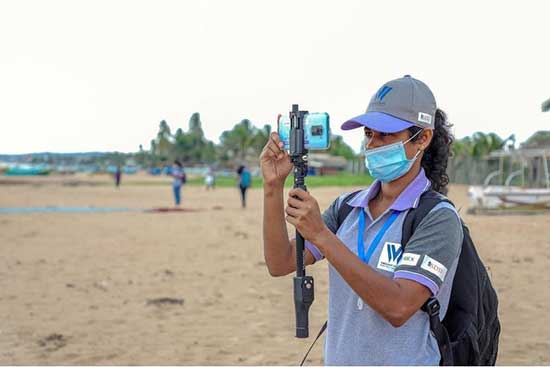
Sri Lanka’s first ever sign language journalist Suranga Udari made her debut recently with a report on the coastal region in Galle. Udari dealt with pollution, an issue that had affected the country in spite of promises made by successive governments to tackle it. It was Sri Lanka’s first ever sign language report.
Suranga Udari was born deaf, but loved journalism. She wanted to become a journalist from a very young age. She was nominated by her fellow employees at the Sri Lanka Central Federation of the Deaf to participate in a five-day intensive residential training camp conducted by Vibrant Voices; a programme dedicated to support organizations that work for marginalized communities. The programme supported Udari in realizing her dreams of becoming a journalist through its weekly news magazine “MediaCorps Watch.” The news magazine featured Udari’s first ever news report on the 1st of January 2021, following which she was extended an invitation to work as a journalist in one of the leading News organizations in Sri Lanka.
“I have five siblings, two of them are deaf. My parents can both hear so can my three other siblings. Growing up it was incredibly difficult for me to learn from a school that is equipped for hearing children. However, I was determined to learn, signed Suranga Udari who was assisted by a sign language interpreter at the Sri Lanka Central Federation of the Deaf, Janaka Ranasinghe. She signed “I sometimes had to copy notes from hearing children in order to learn a certain subject when I was in school, it wasn’t easy. But my parents took a major role in teaching and guiding me in my learning process”, she signed.
Suranga Udari, a resident of Ahangama, worked as a Graphic Designer for seven years after completing her formal education up to the G.C.E Ordinary Level at the Shariputhra College Ahangama, Galle, and completing a year-long diploma in Computer Software at Lake House. She signed that she was never the one to be discouraged by any of the challenges she had to face in life as she has always been inspired to become a journalist. Despite her passion and interest in the field of media and journalism, becoming a part of a media organization, let alone a journalist, was out of reach for Udari as she was never given an opportunity to pursue a career in journalism.
Stephanie Lazarus, Programme Coordinator, SDJF (Sri Lanka Development Journalist Forum) told The Island the outfit was glad it was able to help Udari.
As per the Department of Census and Statistics’ 2012 report – the latest report in the public domain – Sri Lanka has a deaf population of more than 400,000. The community faces many obstacles in having access to quality formal education, employment opportunities and obtaining a driving license to facilitate their own travel.
At a time when digital literacy is considered as one of the main tools needed to learn and communicate, people with disabilities, including the members of the deaf community, are not provided with the specialized technical support by any government or non-government organization to adapt to the new normal.
Join the conversation and let us know what you think about the current structures in place to help people with disabilities by sending us an email to: mediacorpwatch@gmail.com.
For more information: www.ldjf.org | Facebook : Facebook/ MediaCorps watch

News
The use of local organic Agricultural products in the Bakery Industry will strengthen both local farmers and the tourism industry – PM


Prime Minister Dr. Harini Amarasuriya stated that the use of local organic agricultural products in bakery production would provide significant support to both local farmers and the growth of the tourism industry.
The Prime Minister made these remarks while addressing the Annual meeting of the All Ceylon Bakery Owners’ Association, held at the Shangri-La Hotel, Colombo, on Friday (12 June).
The Prime Minister stated,
“At a decisive moment when the country is moving towards a new phase of economic transformation, I believe that the bakery industry has the potential to become a key driver of the national economy, rather than remaining limited to flour-based products alone.
The food production must be mainly considered the quality and safety of food. Therefore, instead of focusing solely on taste, we should introduce nutritious and healthy products to the market that are free from artificial flavourings and colourings.
By using ingredients such as rice flour, finger millet, foxtail millet, green gram, and indigenous tubers to create value-added products, the bakery industry has the opportunity to capitalize on the growing global trend towards health-conscious diets.
The use of local organic agricultural products in food prepared for foreign tourists will provide substantial benefits to local farmers while also contributing to the growth of the tourism industry. At the same time, the government remains committed to strengthening local entrepreneurs by reducing challenges related to the importation of raw materials, providing concessionary loans for new technologies, and offering the technical assistance required to meet international standards.
The government has already launched programmes through the Ministry of Industries to provide the necessary training and market linkages to help small and medium-scale bakery owners develop and expand their businesses”.
The occasion was attended by the Deputy Minister of Industries Chathuranga Abeysinghe, President of the All Ceylon Bakery Owners’ Association N.K. Jayawardana, and a number of members of the Association were also present at the event.



Prime Minister’s Media Division

Prime Minister Dr. Harini Amarasuriya met with a delegation from the UNICEF on Friday (June 12) at Temple Trees to discuss ongoing efforts to support the recovery of the education sector following the impact of Cyclone Ditwah.
Discussions focused on the implementation of activities outlined in the report titled “Cyclone Ditwah Education Emergency Response Plan: Phase 1 Progress Updates (January–April 2026).” The meeting provided an opportunity to review the progress achieved during the initial phase of the response and to discuss future interventions aimed at supporting children and schools affected by the disaster.
The Prime Minister and the UNICEF delegation also exchanged views on strengthening collaboration to ensure the continuity of education and the well-being of affected children.
The UNICEF delegation included Emma Brigham, UNICEF Representative, Begona Arellano, Deputy Representative, and other UNICEF officials.

(Prime Minister’s Media Division)

Can a country put a fixed limit on its population? That is the question Switzerland will be answering on Sunday when voters go the polls to decide on a proposal to cap their population at 10 million, a move that has exposed divisions about immigration in the Alpine nation.
The move is backed by the right-wing Swiss People’s Party, which describes it as a “sustainability initiative” aimed at easing pressure on housing, public services and the environment. However some voters see this as the party’s latest anti-immigration move.
Dubbing it a “chaos initiative”, the government, other political parties, business leaders and trade unions argue it will deprive hospitals and hotels of much needed staff, and damage hard-won relations with the European Union, leaving non-EU member Switzerland isolated in a very risky world.
Switzerland’s population has grown rapidly since 2002, when it stood at 7.3 million. Now it is 9.1 million, 27% of whom are Swiss residents who were born abroad.
Switzerland’s system of direct democracy means all major decisions are taken via the ballot box. Campaigners simply have to gather 100,000 signatures to ensure a nationwide vote.
Many voters are concerned by overcrowded trains, expensive apartments and rising health costs.
The latest opinion polls indicate this could be a very close vote.
They suggest voters are inching towards a no vote by a wafer thin margin, with 52% opposed – but polls remain divided, with 45% saying they are in favour of the proposal and a significant number of voters still undecided.
[BBC]

The use of local organic Agricultural products in the Bakery Industry will strengthen both local farmers and the tourism industry – PM

Prime Minister meets with UNICEF delegation

Qatar net late against Switzerland to secure historic first World Cup point

Australia stun Turkiye 2-0 in counterattacking masterclass

Five Indian air force staff killed as transport plane crashes in Assam

New York Knicks win NBA championship for first time in over 50 years

‘Dates have the highest sugar content to fight Coronavirus’

Sunday Island 27 December – Headlines

#SundayIsland 17th December – Headlines

Sunday Island – 28th March

Sunday Island Headlines – 21 March

Sunday Island – 21st February – Headlines
-

 Editorial7 days ago
Probe Sallay’s complaint
-
 News3 days ago
CIABOC summons Yoshitha over his participation in British Navy training programme
-
 News5 days ago
Local firms move millions of dollars overseas for phantom imports: Govt.
-
 Midweek Review5 days ago
July 09: An inexcusable overall security failure and exceptional contingency plan
-

 Opinion6 days ago
Could Sri Lanka once again face an economic crisis similar to 2022?
-

 News5 days ago
AI raises concerns over arrest of Sallay and rapper under PTA
-
 News6 days ago
Sallay refuses to end hunger strike unless probe is taken out of CID led by Shani
-
 Latest News5 days ago
Iran and Israel say they will pause strikes but warn of retaliation if ceasefire breached again