
Features
The Prabhakaran movie full of inaccuracies


by S. Ratnajeevan H. Hoole
According to IMDb “The Movie [Methagu] shows the true events that happened in Tamileelam to suppress Tamil ethnicity and it is talking about how and why Tamil leader Prabhakaran emerged in the Tamil freedom struggle in the Indian Ocean Island nation Sri Lanka.” Not all events are true as I explain.
According to Wikipedia, Methagu (transl. His Excellency) is a 2021 Indian Tamil-language political thriller film based on the life of the LTTE leader Velupillai Prabhakaran. The release of the film was postponed several times due to legal issues, but finally had the digital release on 25 June 2021.”
The movie really concerns Prabhakaran’s early life up to the murder of Jaffna Mayor Alfred Duraiappah. It cost US$80,000 to produce and credit is given at the end to many persons from all over the world for helping produce it.
The film, however, is effectively banned in Sri Lanka by arresting persons in possession of a copy, presumably because it has been released by “Thamileela Thirai Kalanjiam.” Many of my students (born after the events of the film had taken place) have seen it and pass it around hush-hush on thumb-drives. Given the mixed opinions among them or reluctance to give an opinion, I had to see it – which I did when I went recently to visit my children in California.
The film has several flaws. I will mention only some in this review.
Casting
Only the person acting for Srimavo Bandaranaike has given her name, Lizzie Antony. She is a Tamil Nadu actress. All the others have only one name, presumably a pseudonym. The one acting for Prabhakaran, is Kutti Mani! They all want anonymity I think because our government is so vindictive.
While that is ok, what is not is that many of the actors do not fit the characters they portray. It should have been easy to find actors who look at least a little like the characters they portray. Prabhakaran’s father with a full head of hair at age 80, Veluppillai, is balding when Prabhakaran is born and has the same hair some 25 years later. Only Prabhakaran’s mother is seen to age with dignity as the film progresses.
SJV Chelvanayakam who nearly always is in a cream-coloured suit and had a full head of hair to his end, is bald when he signs the BC Pact, and is seen in a checked kurta instead of the white verti-national that he occasionally wore with no collar. Bandaranaike’s suit seems out of a Hindi movie just like the kurtas worn by actors. His kurta has a collar. However, he is presented in good light, but unbelievably speaks ungrammatical English in the badly written script in discussing racism with Srimavo: “Up to where this racism will lead to, is not known to me.”
Alfred Duraiappah in real life had a green Fiat. In the movie he has a silver Ambassador presumably because that is what they could get in India. India does make foreign cars now and probably did not make the relevant Fiat model from the 1970s. For other inconsistencies, see the photos shown. I will move on to historical errors.
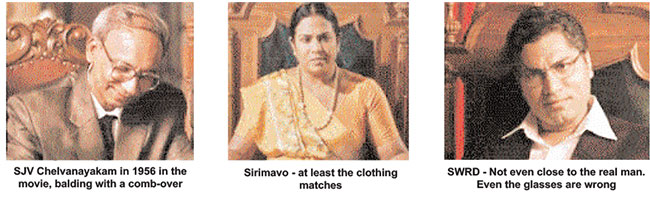
Alfred Duraiappah
I knew Alfred personally. Although I did not respect his politics, he is maligned a lot more than he deserves. His political position was to work with the government to get Tamil rights. It is a legitimate position. We did not like that because it was a horrid government. We who were young then regarded all who sucked up to Srimavo as traitors and that is enunciated by Prabhakaran in the movie.
The movie narrates that Duraiappah would do anything for office whereas the fact is the people of Jaffna elected him Mayor. He was a suave operator. When an uncle of mine, K. Nesiah, wrote a harsh editorial in The Cooperator about him, the next time he saw my uncle waiting for a bus, he stopped, offered him a lift, made good conversation, and told him “Sir, next time you write please be kind to me.” It is difficult to write against a man like that. As Mayor he built up the new market whereas the FP when it controlled the Council was good only at making speeches. I sensed that, after he developed Jaffna so much, people did not object to his giving away shops for a charge saying that when a cow does good work threshing the rice paddy it would eat a little. But we the youth did not buy such arguments.
Where he went wrong is that he held out to the world that Sirimavo was popular despite what she did to us through Standardisation. It was a time when imports were stopped. We in Jaffna, practically everyone, desperately needed bicycle tyres, then manufactured only by the government’s Kelaniya Tyre Corporation. Alfred as Mayor had complete control as they were sold through the Cooperative Stores. We lined up at the Mayor’s office and got him to give a chit to the Coop authorizing the sale of two tyres. In exchange we had to pay Rs. 2 and sign the SLFP Membership form. When I stood in line, he saw me and came out saying “Hello young Hoole” and gave me the authorization without my having to join the SLFP. It was widely said that Srimavo was so impressed with the torrent of new members as Tamils were joining the SLFP in droves, she gave him jobs to distribute which he did for a charge. There were other stories among the youth. The youth were furious and the sale of jobs undid him. Sirimavo it was said was shocked that he lost the 1975 election despite getting so many members.
The International Tamil Conference
The real numbers at the conference were much bigger than shown in the movie, and Veerasingham Hall a lot more spacious that the hall they could find in India for the movie. The claim is made that nine people were killed and they show the police beating up the crowd and killing a conference organizer by stepping on his neck. As the three-member Commission appointed under Justice de Kretser showed, the police went to arrest an international participant who, having been denied a visa in India, applied in Malaysia and came for the conference that Srimavo wanted in Colombo where she could make it a show piece under her.
She was furious and asked the police to deport the man. Alfred played no part in disrupting the conference as claimed in the movie. The police while going in a jeep to the venue, found people seated and listening outside the hall. The jeep was driven into them, and the public reacted by overturning it. The police fired into the air, the electric wires dropped on the galvanized pipes placed for crowd control. Those in contact with the pipes were electrocuted. One of the nine was my dear OL mathematics teacher at St. John’s College, Mr. Sigmaringam who ran home in panic and died of a heart attack. There was an attack by the police insofar as they drove into the crowd and beat the crowd when they threw sand at the police but no attack so savage as depicted in the movie. No conference organizer was killed by ASP Jaffna stepping on his neck as depicted.
Correcting accounts like this in the movie is difficult, perhaps foolhardy, because as someone once asked me, “So are you saying the police were nice?”
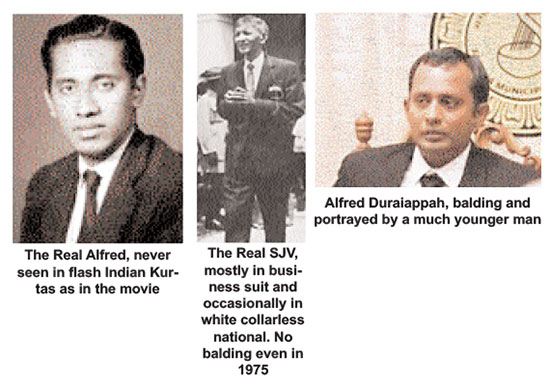
Pon Sivakumar
Pon Sivakumar bombed Duraiappah’s car while he had his regular tea at Premier Café across my home on 2nd Cross Street. A scene in the movie shows Prabhakaran plotting and saying we must hit back. “Who?,” they ask. They think of Srimavo and then she being big they think of a traitor. When asked which traitor, Prabhakaran says Duraiappah. But then, instead, Sivakumar (a friend of mine) is sent to kill ASP Chandrasekera.
Sivakumar wears a clean, white, long-sleeved shirt and tie which I doubt he ever wore except for his OL Identity Card photograph. Although he dropped out with the OLs (before or after passing I do not know) an A-Grade school principal told me very seriously that he had entered the university but rejected his seat to engage in the Tamil struggle.
In the movie Sivakumaran goes to shoot the ASP, the gun misfires and he bites a cyanide capsule and dies promptly. In truth he went to rob a bank, something went wrong, and the bank guards gave chase and villagers, not realizing who he was, joined the chase. Recognizing that his capture was inevitable, he bit the cyanide capsule (I believe in Neerveli) and died three days later in Jaffna hospital.
The movie scene from 1974 shows, as part of Sivakumar’s reading, the book “Bourne Ultimatum.” It is a 1990 novel by Robert Ludlum. I do not think any of them could read English at that level. It is how nationalist myths are made.
Questionable Accounts
The finale of the movie is where Prabhakaran murders Alfred. Respectable histories question if indeed Prabhkaran was the murderer of Alfred.
In the movie Prabahakaran’s supposed sister Kayal is molested by a police constable whom she kills by banging a pot on his head. I am not aware of such an incident.
A Buddhist monk, presumably a general figure for all racist monks, says very offensive things of Tamils. He says that he wants Tamils not to obey the Sinhalese but to fear them. He adds, “The weapon of education must not be in Tamil hands. Tamils are educated and working for the government. If this goes on, we will be their slaves. We must first reduce the close relationship Tamis have with Tamil Nadu. Tamils are strengthened by this relationship. If this continues, we will have no land. Are we to commit suicide? We must stop Tamils studying.”
Srimavo agrees and this is the precursor to standardization. The real story of Standardisation is far more complex than that, although some crazy Sinhalese people might have thought like this.
Prabhakaran invents the slogan “Student’s Sakthi is very big Sakthi. If education goes, a generation goes.” Hearing of the real incident of the burning of the Hindu Priest by Sinhalese mobs in Panadura, Prabhakaran asks “Why do we not hit back?”
I can go on. But with so many errors and truths mixed up, I will not repeat all aspects of the narrative.
Censorship
In a democracy censorship is to be eschewed. A free discussion will bring out what aspects of the movie are credible and what not. In sum, the government has overreacted by banning the movie, even that being not by a formal gazette but through fear by arresting persons in possession of the movie. That enhances the arbitrary powers of the police. That will only increase the value of the movie and make more people want to see it. Indeed, if I had not seen the movie to write this, many young people will believe all that is in it. Whose good does it serve?

Features
Will new UGC Circular 06/2026 strengthen or weaken open and distance learning in Sri Lanka?


Balancing Quality Assurance with Educational Access
Sri Lanka’s higher education system has long sought to balance two equally important national objectives: maintaining academic quality while expanding access to university education. Open and Distance Learning (ODL) has been one of the country’s most successful mechanisms for achieving this balance, particularly for working adults, teachers, government officers, rural communities, and thousands of students who were unable to enter conventional degree programmes. In addition to undergraduate and postgraduate degrees, sub-degree qualifications such as Certificate, Diploma, and Higher Diploma programmes have gained remarkable momentum over the past two decades. These programmes have become increasingly popular by providing flexible, affordable, and employment-oriented learning opportunities for school leavers, working professionals, and aspiring entrepreneurs.
With the introduction of the new UGC regulatory framework, these sub-degree programmes also come under a more comprehensive system of oversight. Strengthening quality assurance and protecting academic standards are legitimate policy objectives that can enhance the credibility and recognition of university qualifications. However, the expansion of centralised regulation also raises important questions regarding institutional autonomy, flexibility, and the future growth of Open and Distance Learning.
Globally, higher education is increasingly moving towards greater institutional autonomy, decentralised decision-making, flexible programme delivery, and innovation supported by robust quality assurance mechanisms. Sri Lanka, however, appears to be adopting a more centralised regulatory approach. While greater oversight may improve accountability and consistency, excessive centralization risks reducing institutional flexibility, slowing innovation, increasing administrative burdens, and limiting the ability of universities to respond quickly to emerging educational and labour market needs. The challenge, therefore, is not whether regulation is necessary, but whether it achieves an appropriate balance between ensuring quality and preserving the autonomy and adaptability that have been central to the success of Open and Distance Learning.
Greatest Concern
The greatest concern is whether the new regulatory framework may unintentionally reduce access to higher education, particularly in regional universities that have historically served disadvantaged communities. Universities such as Sabaragamuwa, Uva Wellassa, Rajarata, Wayamba, South Eastern, Eastern and several others were established not only to decentralize higher education but also to stimulate regional development. Their external degree and distance learning programmes have become an important bridge connecting universities with rural populations.
These programmes have enabled thousands of school teachers, public servants, private-sector employees, farmers, entrepreneurs, and young adults from economically disadvantaged families to obtain university qualifications without relocating to major cities. For many families, Open and Distance Learning is not simply another educational option, but also it is the only realistic pathway to higher education.
The sustainability of many Open and Distance Learning (ODL) programmes has faced challenges for several years. Some programmes have struggled to demonstrate strong labour market outcomes, particularly where curricula have not evolved in line with changing industry needs. However, this is only part of the picture. In many disciplines, especially agriculture, agribusiness, community development, media and vocationally oriented fields, diploma and certificate holders have become successful entrepreneurs, agricultural extension workers, and local development leaders. Therefore, the value of external education should not be assessed solely by graduate employment statistics but also by its contribution to entrepreneurship, lifelong learning, rural development, and community empowerment.
Less Discussed Challenge
Another, less discussed challenge is the institutional attitude towards external education. Over the years, Open and Distance Learning programmes have sometimes faced resistance from sections of the university community, including internal student groups, some academics, administrators, and policymakers. Concerns over resource allocation, workload, infrastructure, and institutional priorities have occasionally created tensions between internal and external programmes. Rather than viewing these programmes as complementary components of a university’s mission, they have sometimes been perceived as competing for limited resources. Such perspectives can discourage collaboration and prevent universities from making the most effective use of shared academic expertise, facilities, and infrastructure. As publicly funded institutions, universities have a responsibility to maximise the use of their academic resources for the benefit of society. The challenge is not to choose between internal and external education, but to develop policies that promote equitable resource sharing, mutual respect, and efficient utilization of facilities while maintaining high academic standards for all learners.
Academic staff engaged in Open and Distance Learning (ODL) programmes frequently receive relatively modest remuneration considering the substantial additional responsibilities involved, including course design, online and face-to-face teaching, travel, student mentoring, assessment, and quality assurance activities. In recent years, higher personal income tax rates on additional earnings have further reduced the financial attractiveness of external teaching for many academics. Consequently, some experienced lecturers are becoming increasingly reluctant to participate in ODL programmes, creating a growing challenge for universities in recruiting and retaining qualified teaching staff. If this trend continues without appropriate policy interventions, it may adversely affect the long-term sustainability, quality, and expansion of external education.
There are also concerns that the implementation of the new UGC circular with its additional regulatory requirements and financial ceilings on programme operations and staff remuneration, where applicable may further reduce institutional flexibility and academic participation. If these concerns are not carefully addressed through consultation and periodic policy review, the combined effects of increasing regulatory constraints, financial disincentives, and declining academic participation could undermine the future growth and sustainability of Sri Lanka’s Open and Distance Learning sector. At the same time, programme operating costs have increased substantially due to inflation, technology investments, administrative expenses, and taxation. Consequently, tuition fees have risen, making university education increasingly difficult for lower-income students.
If additional regulatory requirements significantly increase administrative complexity or operating costs without corresponding institutional support, there is a legitimate concern that some programmes may become financially unsustainable. The result could be a gradual reduction in course offerings, fewer academic staff willing to participate, declining student enrolments, and ultimately the closure of programmes that have served rural Sri Lanka for decades. Such an outcome would conflict with one of the fundamental purposes of public universities that to expand educational opportunities beyond urban centres. Quality assurance should never be compromised. Students deserve programmes with qualified academic staff, robust assessment systems, modern learning technologies, and effective student support services. Public confidence in university qualifications depends upon maintaining high academic standards. Nevertheless, quality assurance should function as an enabling framework rather than becoming an administrative barrier. Policies should encourage innovation, flexibility, and accessibility while ensuring accountability. The challenge is therefore not whether regulation is necessary, it certainly is, but whether regulation has been designed with sufficient consideration of institutional diversity. Regional universities operate under financial and human resource constraints that differ considerably from those of larger metropolitan institutions. A uniform regulatory framework may therefore produce unequal consequences across the university system.
Broader socioeconomic impact
Another important consideration is the broader socioeconomic impact. Open and Distance Learning contributes not only to education but also to local economies. Regional study centres create employment opportunities, stimulate local businesses, generate demand for accommodation and transport, and support digital infrastructure development. More importantly, they allow educated professionals to remain within their communities while upgrading their qualifications. In an era where governments emphasize lifelong learning, digital education, workforce reskilling, and inclusive development, policies should strengthen but not unintentionally weaken the national Open and Distance Learning ecosystem.
The University Grants Commission should therefore consider establishing a comprehensive consultative review involving universities, academic staff, students, employers, quality assurance experts, and regional stakeholders before full implementation of major regulatory reforms. Such a review could identify practical adjustments that preserve academic quality while ensuring that regulations remain realistic, affordable, and supportive of institutional sustainability.
Higher education policy should not only regulate universities; it should also empower them to fulfil their national mission. Sri Lanka cannot afford to reduce educational opportunities for those who have the fewest alternatives. For thousands of working adults and rural students, Open and Distance Learning represents hope, opportunity, and social mobility. Any reform affecting that opportunity deserves careful consultation, thoughtful implementation, and continuous evaluation.
The ultimate objective should be clear: to improve quality without sacrificing accessibility, to strengthen accountability without reducing opportunity, and to ensure that Sri Lanka’s universities remain engines of inclusive national development rather than becoming institutions accessible only to those who can afford conventional education.
Disclaimer:
The views expressed in this article are solely those of the author, presented to encourage constructive discussion on higher education policy reforms, and do not necessarily reflect the views or positions of any institution or organization with which the author is affiliated.
About the Writer:
Prof. M. P. S. Magamage is a senior academic at the Sabaragamuwa University of Sri Lanka and a distinguished scholar with extensive international experience. He is a Fulbright Scholar, Indian Science Research Fellow, and Australian Endeavour Fellow, and has served as a Visiting Professor at the University of Nebraska–Lincoln, USA. Beyond his academic achievements, Prof. Magamage has played significant roles in national policy and disaster-related governance, higher education policy development. He can be contacted at magamage@agri.sab.ac.lk.
by Prof. M. P. S. Magamage

Tales of Mystery and Suspense 11
After the horrors of modernity and the absurdity of murder in the midst of the preposterous Ballet Stroganoff, I turn to more orthodox crime fiction. It fits into the tradition of the golden age of crime fiction, though it was not published between the wars, but rather in the fifties.
It was a quintessential Oxford book, written by Michael Innes, the pseudonym of the Christ Church English don J I M Stewart. I read it in a quintessentially Oxford setting, the Chalet in the French Alps where in the seventies I had been to several reading parties.
I was not really a Chalet type, for most of the others from the College were from British public schools, blond and athletic, though the patron as we called the Senior Tutor who ran our parties did ask exceptions to add to the mix, such as my fellow classicist Reggie Oliver now well known for collections of horror stories. But they too walked, whereas after my first effort, up the hill to the restaurant hotel which supplied our wine, I said firmly I would not walk again.
So, I would sit in the chalet and read, for it had a wonderful collection of books, dating from the previous century when it had been founded by a famous Balliol don. And last year, when I was asked if I would like to join a party for former Chaletites, I found after I had staggered down to the place from the hotel – now only a restaurant – that it would be best not even to try that short walk until the time came to leave.
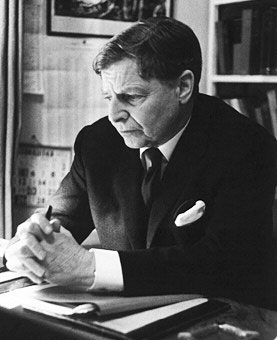
Stewart
I had five days of tranquil bliss, marvelling at the two other older men who did walk, but quite content with my books. And having reread a book I had loved half a century earlier, I turned to thrillers of which there was a great collection.
I had enjoyed the few Innes books I had read previously, but this one was new, and apt for it began with a reading party. Appleby Plays Chicken (also known as Death on a Quiet Day) features his favourite detective, Police Commissioner Sir John Appleby. The party was not in the Alps but in a quiet English village, and begins with a game of chicken involving fast driving, which leads the thoughtful undergraduate who sensibly chickened out going for a long walk the following day. During the walk, he comes across a dead body, and realizes that the murderer must be the man he sees walking away on the other side. But he comes up and seems to be helping the boy with the investigation, when he suddenly pulls a gun.
That leads to a long chase over the moors, with other sinister figures popping up, though the last one turns out to be Appleby, who had noticed blood on the shoe of the boy who had been put into an ambulance. Finding himself in a police station, the boy relates what happened, and the two of them go back to the tor, only to find another dead body there. But this belongs to someone else, in fact the man who had appeared on top and pulled out a pistol. And his murderer is on another hill nearby and nearly knocks off Appleby.
He gets away, despite the police cordon Appleby had summoned, and the story moves to the hotel and two strange people there, a man who the students think is a clergyman, and a military man whom Appleby says is a blackmailer. Then a message comes to the don in charge of the party, that his brother, a landowner in the neighbourhood, was missing, presumed drowned.
Meanwhile the supposed clergyman is waiting for his daughter, who it seems was the young lady in a car which seemed to offer refuge to the fugitive boy, but when he next came across it his pursuers had taken it over. A telegram comes from her to say she was staying over with her friends, but the boys realize that it had come from nearby, and they hare off in pursuit.
Appleby and the don and the clergyman and the military man go to the house of the drowned brother and then follow the youngsters to a tower where they believe the girl is being kept. Appleby tells the original young man to go first, and then the others follow, to find the girl and the clergyman and the military man all together there, which leads to a dramatic conclusion, in which the villain falls to his death and the don follows in trying to save him.
It turns out that this is a spy story too, the brother having been blackmailed by the man who killed him when he burnt on the tor the papers that were wanted. Then the mastermind killed the blackmailer, and the don, coming across the bodies, decided that his brother had to disappear, in a bog, to avoid disgrace. He then took his clothes to the shore by his house so that he could be presumed drowned.
And the girl was an accomplice, while the clergyman was the mastermind, which became clear when he fell into the trap of writing a blackmailing letter on the military man’s typewriter. But this was after Appleby had damaged it slightly so the fact that it was typed in the latter’s absence could be identified.
All very complex, and eccentric as Innes is wont to be, but wonderfully exciting, if quite different from the reading parties I was familiar with.
During the colonial era, Sri Lanka had a stronger economy than Singapore. Over the past seven decades, however, the two countries have followed sharply different paths. Singapore’s rise as a global economic hub is often attributed to three core principles: meritocracy, pragmatism, and honesty.
Critics argue that Sri Lanka’s problems reflect a failure to uphold these principles, a point that needs little proof, as we have seen it all firsthand. Today, there is renewed interest in restoring these values to governance, especially pragmatism and honesty, both of which Sri Lanka urgently needs. Meritocracy, however, is not that simple: the ways merit is assessed and acquired can undermine the very purpose meritocracy is meant to serve. While Sri Lanka must embrace meritocracy, we must take measures to prevent it from drifting into the dark side.
Meritocracy is commonly defined as a social, political, or economic system in which people are chosen for positions based on ability, talent, and effort, collectively called merits, rather than wealth, class, or inherited privilege.
Sri Lanka has a deep-rooted culture that not only tolerates but often venerates inherited privileges such as nepotism—advancement based on family ties or close personal connections; patronage—rewards and positions given in exchange for loyalty or political support; cronyism—favours given to friends or allies, especially in business or politics; aristocracy—power based on inherited status, class, or birth; and oligarchy—power held by a small, privileged group. These are legacies of a long history of monarchy, colonialism, and feudalism. Furthermore, social divisions based on religion, ethnicity, and caste add to the complexity. Our culture has a way of resigning itself to these social injustices by attributing them to fate or bad karma.
These deep-rooted practices have all but replaced meritocracy, causing immense damage to the country’s economy and social fabric. Therefore, adhering to meritocracy seems the obvious thing to do, but there are two unseen problems lurking beneath. First, an individual’s ability to earn merits depends on many factors, and the opportunities for earning merits are not equally available to all, a legacy of our past unjust practices. For those who have less or no opportunities to earn merits, the competition is over even before it begins.
Merit not a single universal quality
Second, “merit” is not a single universal quality. It varies with the job or position. A pilot, teacher, farmer, judge, engineer, and political leader each require different forms of ability, judgment, discipline, and responsibility. Therefore, merit must be assessed according to the demands of the role, not merely by the results of a standard test or formal qualifications, as practiced today. If we practice meritocracy under the present conditions, we will not get the expected outcome: meritocracy. Ironically, a cyclical process.
Therefore, adhering to meritocracy while ignoring the conditions that rob the opportunities to gain merits will only perpetuate unjust and outdated systems under the pretext of fair and progressive reform. Merit is a wonderful way to choose a pilot, but a terrible way to decide who deserves a dignified life.
This is a complex issue, and Sri Lanka has tried to address it in many ways in the past, with questionable, if not disastrous, results. The key point of this analysis is that our definition of merit is narrow and misleading. “Merit” is rarely an objective, universal metric. What one organisation values as merit may differ drastically from another. Our system equates merits or skills with the ability to perform on tests, starting from Grade five through final examinations at university. That is a problem as it does not measure the ability to do a job successfully.
Standard tests measure convergent thinking, that is, finding the single correct answer to a problem, but they completely miss identifying divergent thinking, which involves generating novel, creative solutions where no single answer exists. In other words, it is the ability to be “street smart” when confronted with real life problems that counts. Not the ability to cross the box in a test paper. Convergent thinking can be quantified; that is what test scores provide, and that has become the standard currency of merit in our society. On the other hand, there is no test to quantify the divergent thinking ability needed to solve complex problems on the ground. It is that skill we need to identify and nurture if we are to succeed economically and socially as a country.
The sunset example
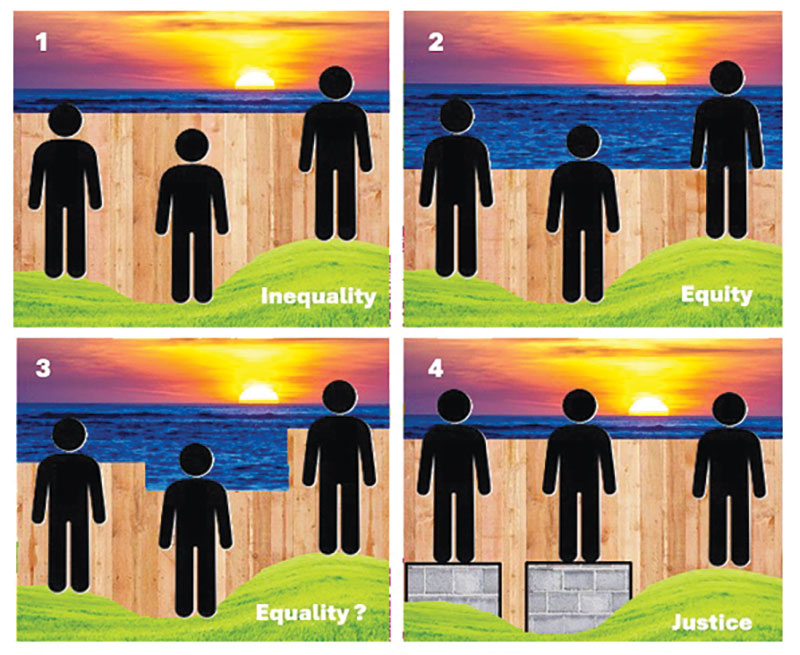
A few terms used in relation to this subject need clarification: in the first scenario presented in the illustration, only the person standing on the highest ground can enjoy the sunset. The fence, which may have been erected for safety or as a boundary, blocks the view of the two people on lower ground. This is inequality. If the height of the fence were lowered enough for all three people to see the sunset, as in the second scenario, that would represent formal equality: treating everyone the same, regardless of where they stand. It seems fair, but it has drawbacks.
First, when the fence is lowered, the original purpose of the fence may be compromised or lost. If the fence were built for safety, someone on higher ground could trip and fall over the cliff on the other side. Second, the person on higher ground could still see the sunset for longer than the others. For example, if one person’s position is one foot higher than another’s, he or she could see the sunset about 4.2 seconds longer; if the difference is 1,000 feet, the sunset lasts about 2 minutes and 13 seconds longer. In other words, the person on higher ground still has an inbuilt advantage. This is true in real life as well. In the third scenario, the fence is lowered proportionally. There is an appearance of equality, but the longer sunset enjoyed from higher ground has not been addressed. In the fourth scenario, conditions have been equalized in a more justifiable way.
That is the theory. British sociologist Michael Young is credited with coining the term meritocracy in his 1958 satirical book The Rise of the Meritocracy. He warned that a pure meritocracy could create a permanent, arrogant ruling elite whose members believed they owed all their success solely to their own efforts, while making the lower classes feel entirely responsible for their poverty. Scholars across the developed world are raising concerns about the outcome of true meritocracies, including in our model country, Singapore (Ong Ye Kung, 2018).
Permanent arrogant ruling elite?
Create a permanent, arrogant ruling elite? That is a dire warning we cannot ignore. Such a condition can create new divisions, disrupt national unity, and damage economic development. Sri Lanka has experienced enough of it: two youth uprisings, a civil war, ongoing social tensions, and a failed economy. Let us be clear, deep down, the root cause of these conflicts is the lack of equal opportunities to participate in the country’s economy and earn a decent living. Those with ulterior motives may give different meaning, but that is the reality. We cannot afford repetitions.
Tests that measure convergent thinking ability by asking how quickly one can find the single correct answer to a carefully structured problem. The test taker’s ability to answer such questions does not depend on education alone, but it also depends on family status and support, social background, nutrition, safety, and access to networking. In some cases, geography, disability, caste, ethnicity, religion, and political influence also come into play. Unequal opportunities create unequal merit. Therefore, a purely meritocratic system can appear fair while still rewarding advantages accumulated long before competition begins. When there are so many factors in play, equalising all of them, creating a just environment, let alone the most crucial factor, education, can be a herculean task.
The better alternative is to use a measure of divergent thinking ability, but that presents several problems. Divergent thinking is the thought process used to generate creative ideas by exploring many workable solutions. Instead of looking for a single, correct answer, which is convergent thinking, divergent thinking expands outward in multiple, non-linear directions. It is often spontaneous, free-flowing, and associated with “thinking outside the box.” Convergent thinking ability peaks during early adulthood and diminishes with age, whereas divergent thinking ability increases throughout life. Experience counts. Therefore, to assess divergent thinking ability, it is necessary to observe an individual’s performance while he or she is facing real-life problems over a longer period than what it takes to do a standard test.
Reasons for reassessing the push
Sri Lanka has other reasons for reassessing the push to establish a conventional meritocracy. According to available data, one-fifth of Sri Lanka’s labour force is employed in the public sector, while the rest is divided between the private sector and informal employment in a two-to-three ratio. This means that more than 60% of the labour force consists of small-scale, unregistered family units, subsistence farmers, street vendors, three-wheel drivers, daily-wage laborers, and independent tradespeople such as plumbers, carpenters, and masons. In addition, it is estimated that about 8.6 to 9.2 million Sri Lankans who can work are not actively looking for employment; more than 71% of them are female.
Promised Justice
The promised “justice” of meritocracy does not reach them. For example, the country had been self-sufficient in rice on many occasions, but rice farmers remain trapped in a cycle of enduring poverty with little hope of escape. Sri Lanka’s Inequality Index increased from 37.7 in 2019 to 39.8, reflecting the disproportionate burden on the informal labour force, even though Sri Lanka was declared an Upper-Middle-Income country by the same monitoring organization. Our system does not provide the opportunity for all citizens to participate in the economy, and that is a major hindrance to economic development.
Success and justice require assessing both the convergent and divergent thinking abilities of an individual as an entry requirement as well as during their performance in the position. The private sector practices this, but the current public sector system fails on both counts. The perils of selecting or electing people who are not qualified to do the job do not need explanation. Sadly, that has been Sri Lanka’s legacy. In addition, the current system fails to assess the job performance of elected or selected people and hold them accountable. Public sector jobs are for life. Pay increases and promotions are predetermined and, unlike in the private sector, are not based on performance or productivity.
This is the fundamental reason for needing education reforms. Our education system was first designed to provide clerical support to colonial administrators. Conditions have changed, but the system remains stubbornly unchanged. The education system is not designed to meet the country’s needs. On one hand, it has created a shortage of qualified people to provide essential services. On the other hand, brain drain fulfills the needs of affluent countries at the expense of hard-earned taxpayer money.
University graudates
In this system, higher education has been enlisted in defining merit and conferring the credentials that a market meritocracy rewards, while distorting the mission of higher education. Many university graduates end up in teaching positions when they have no teaching experience. The same applies to university teachers as well. This writer has seen his share of university teachers who would not have tenure if their students were allowed to grade their performance, as happens in most Western countries.
The lack of a system to evaluate employee performance, particularly in the public sector, is a serious error. In the current system, this is the only opportunity to assess divergent thinking ability, or the so-called soft skills and mindset, which, along with hard skills, are crucial in delivering the intended service and achieving personal growth: actual merit. Instead, public sector employees’ promotions and pay increases follow a fixed timetable, irrespective of their performance. This guaranteed-for-life employment system not only eliminates accountability but also kills motivation to do the job well and discourages innovation. Both individuals and the country suffer as a result.
The other drawback is the social devaluation of vocational skills in favour of professional skills—another residue of our feudal past that refuses to go away. This prestige hierarchy places undue emphasis on university education at the expense of vocational training. Both students and parents are under severe pressure to do well at exams, and this creates a wholesale drive to send children to elite schools in the capital and feed a massive tuition industry. This fixation on a few professions fails to recognise the significance of the other vocational professions to the economy.
Professionals may claim that they have invested more in achieving their skills and deserve preferential treatment, but they should not forget that farmers, plantation workers, and domestic workers abroad, to name a few, contribute to maintaining the infrastructure that allows professionals to earn their merit: the ‘moral desert.’ Society must have the decency to recognise their contribution, not in slogans, but by providing them with the means to lead a decent life.
Even under the best of conditions, meritocracy has become another form of hereditary system, much as aristocracy was. Affluent, privileged parents have figured out how to pass their privilege on to their children, not by bequeathing them land or estates, as in aristocratic societies, but by equipping them to compete successfully and get well-paid jobs, particularly in the private sector, and amass wealth. Meritocracy fails because it turns success into a moral claim, breeds arrogance among winners, creates shame among losers, reproduces privilege, and undermines democratic solidarity. Critics see it as a way to whitewash elitism (Sandel 2021, Markovits 2019, Littler 2017, Frank 2016, Guinier 2015).
Shortcomings
On the surface, meritocracy is the right practice. Indeed, meritocracy must be practiced; one cannot hire a mechanic to pilot a plane just because he is well connected. Yet, even under the best of conditions, meritocracy has shortcomings; and efforts to provide justice in earning merit, as shown in the fourth scenario in the illustration, not only unachievable, but it can create new social problems, as we have seen in our own past. Besides, such measures are only temporary, like medication given for an acute illness. They should not remain in place indefinitely. Lasting solutions must honor the dignity of work rather than credential achievement alone. That will also solve the rampant shortage of qualified workers while addressing the issue of brain drain. Most Nordic countries and some Eastern European countries have found their own solutions to this problem.
Nordic approaches may not transfer directly to Sri Lanka, but one conclusion is clear: our education system must be reformed to address these conditions. Sri Lankans spend more on the thriving shadow education system than the education department’s budget, while other pressing issues get neglected, for example, childhood malnutrition. Education should not merely grant credentials of limited value at home while serving affluent countries at taxpayers’ expense. In Singapore, our model country, meritocracy is not a “moral desert” driven solely by exam competition; it is grounded in “national duty.” We have recognised our past mistakes, but solving such a complex problem needs long-term strategic planning. Therefore, now is the right moment to begin a serious dialogue and include the right strategy in our plan for a happy and prosperous nation.
by Geewananda Gunawardana, Ph.D.

No-confidence motion against Justice Minister should be supported by facts as members’ noise does not establish facts – PM

Develop a programme to allocate underutilised state land for investment by returning migrant workers – President

New Chairman and Members appointed to Delimitation Commission

Kishan, Tilak knocks help India seal the series

Gunaratne 123, Samarawickrama 100* ace 274 chase for 1-1

Savindu, Akeel and Romesh star in Abans Groups’ 8 wicket win

‘Dates have the highest sugar content to fight Coronavirus’

Sunday Island 27 December – Headlines

#SundayIsland 17th December – Headlines

Sunday Island – 28th March

Sunday Island Headlines – 21 March

Sunday Island – 21st February – Headlines
-
 Features7 days ago
Two memorable excerpts from a former SLAF commander’s memoir
-
 Business7 days ago
‘Giving up was never an option’: The fisherman who fought back after losing millions in SL
-
 Life style7 days ago
Taste of the Swiss Alps comes to Colombo
-

 Features7 days ago
Erdoğan’s New Republic
-
 Midweek Review4 days ago
Three high-profile alleged suicides shaping key investigations
-

 News18 hours ago
Fort Magistrate orders arrest of MP Archchuna
-

 News4 days ago
Customs asked to resume probe or face legal action
-
 Editorial18 hours ago
An indictment of all parties